Wisdom over Memory — 智慧超越记忆
Framework-First Cognitive Architecture for AI Agents







SOMA is a lightweight, pluggable cognitive framework that gives AI agents the ability to think, not just retrieve. It organizes memory around an explicit wisdom framework — seven thinking laws that form a reasoning network, not a flat list. Laws chain through relations, combine into synthesized perspectives, and self-correct against cognitive bias. The result: agents that decompose problems systematically, activate relevant knowledge bidirectionally, and evolve their own reasoning over time.
Not "make AI remember more." Make AI understand deeper.
📖 中文文档 | Documentation | Test Reports | Changelog | Contributing
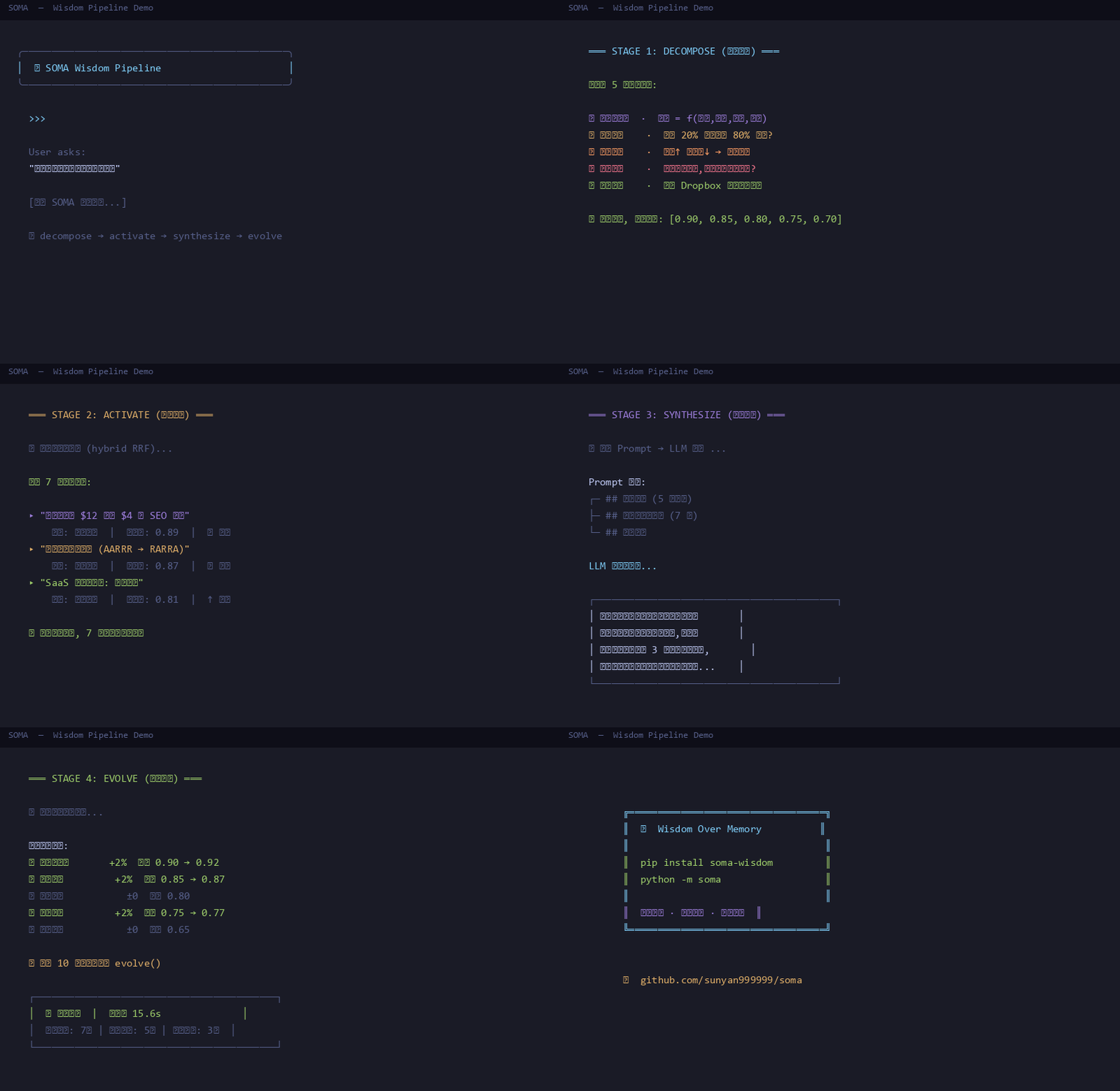
pip install soma-wisdom
python -m soma          # one-command verification
from soma import SOMA
soma = SOMA() # zero-config start
soma.remember(
"First-principles thinking: deconstruct to fundamentals...",
context={"domain": "philosophy", "type": "theory"},
importance=0.9,
)
answer = soma.respond("How to analyze our growth bottleneck?")
print(answer)No API key required for mock mode. Set llm="deepseek-chat" (or any LiteLLM model) for real LLM responses.
┌──────────────────────────────────────────────────────────────────────────┐
│                           SOMA Agent (v0.7)                                │
│  ┌──────────────┐  ┌──────────────┐  ┌──────────────────────┐            │
│  │ WisdomEngine  │→│ActivationHub │→│     MemoryCore        │            │
│  │ · 关键词匹配  │  │ · 双向激活   │  │ · episodic/semantic   │            │
│  │ · 规律链传播  │  │ · 反视角检索 │  │ · skill/sqlite+vector │            │
│  │ · 组合模板    │  │ · 可用性修正 │  │ · 加权RRF+时间衰减    │            │
│  │ · 语义兜底    │  └──────────────┘  └──────────────────────┘            │
│  │ · 语境排序    │         │                  │                          │
│  └──────────────┘         ▼                  ▼                          │
│         │         ┌──────────────────────────────────────────────────┐   │
│         ▼         │               MetaEvolver                        │   │
│  ┌──────────┐     │ · 偏差检测 → 自动调权 → 技能固化                  │   │
│  │复杂度评估 │     │ · 触发词扩展 · 思维模板挖掘 · 动态步长            │   │
│  └──────────┘     └──────────────────────────────────────────────────┘   │
│         │                                                                 │
│         ▼                                                                 │
│  ┌──────────────────────────────────────────────────────────────────┐   │
│  │  v0.6 Reasoning Engine              │  v0.6 Causal Extraction     │   │
│  │  · 17 reasoning templates           │  · Auto-extract triples     │   │
│  │  · Hypothesis + evidence matrix     │  · Lightweight LLM (~200tk) │   │
│  └──────────────────────────────────────────────────────────────────┘   │
└──────────────────────────────────────────────────────────────────────────┘

Twelve-Stage Wisdom Pipeline:
  Assess → Decompose → Chain → Combine → Semantic-fallback
         → Context-sort → Activate → Anti-bias → Reason
         → Synthesize → Causal-extract → Evolve
🧠 Wisdom Chat · 📊 5D Benchmark · 💻 IDE Integration · 🔌 REST API
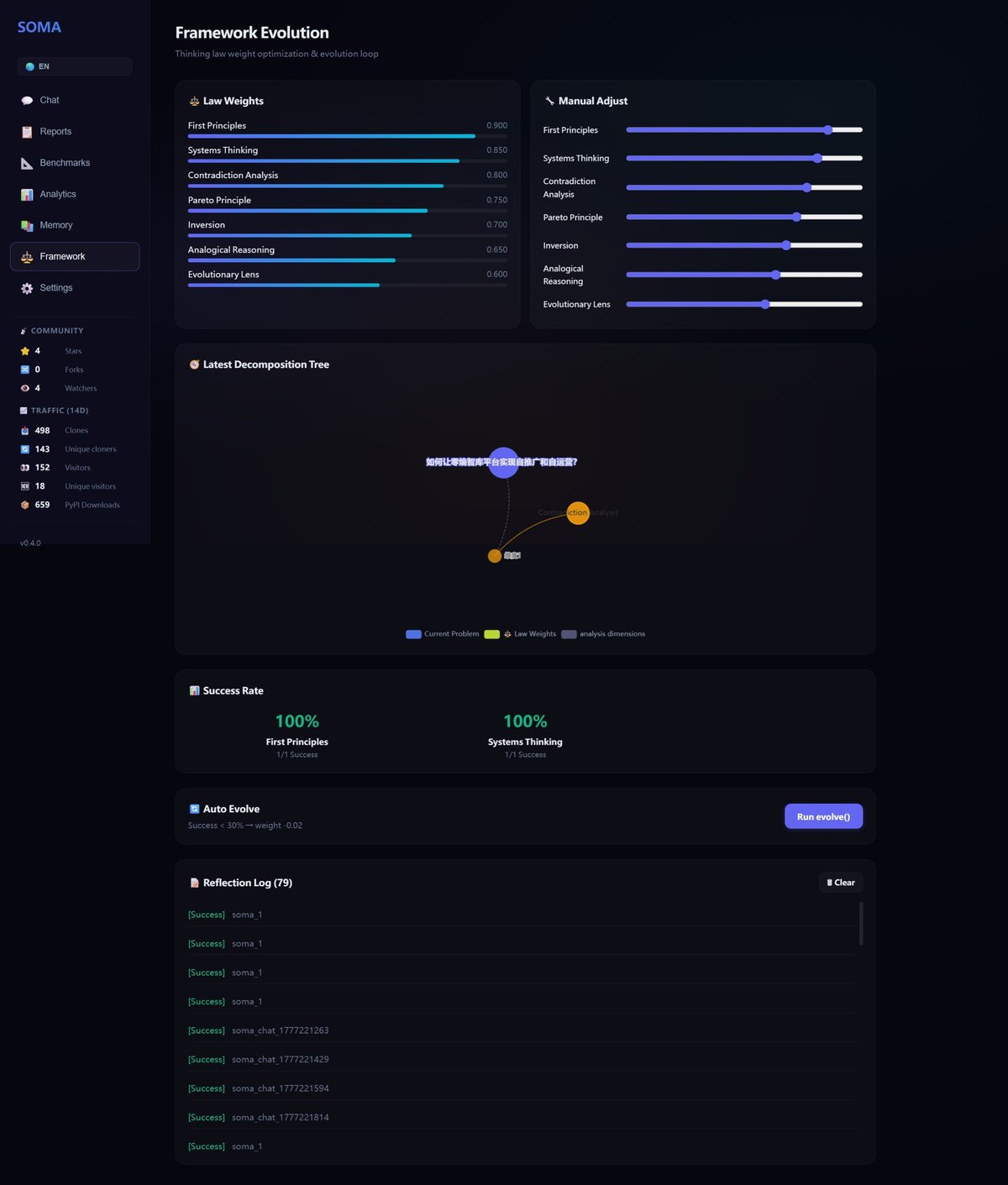 |
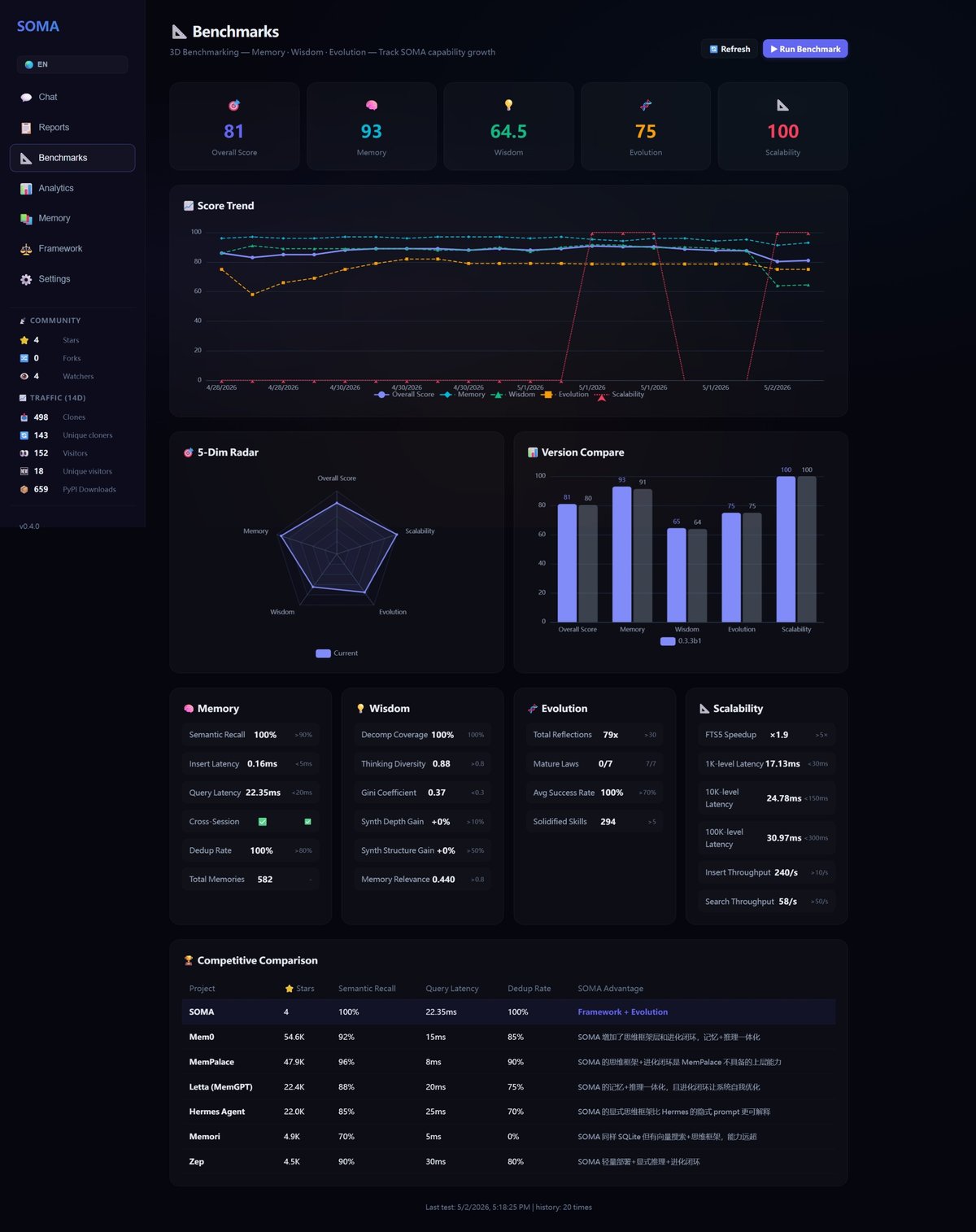
 |
| Wisdom Chat — 7条规律分解问题,双向记忆激活,LLM流式响应 | 5D Benchmark — 记忆/智慧/进化/伸缩/综合,竞品实时对比 |
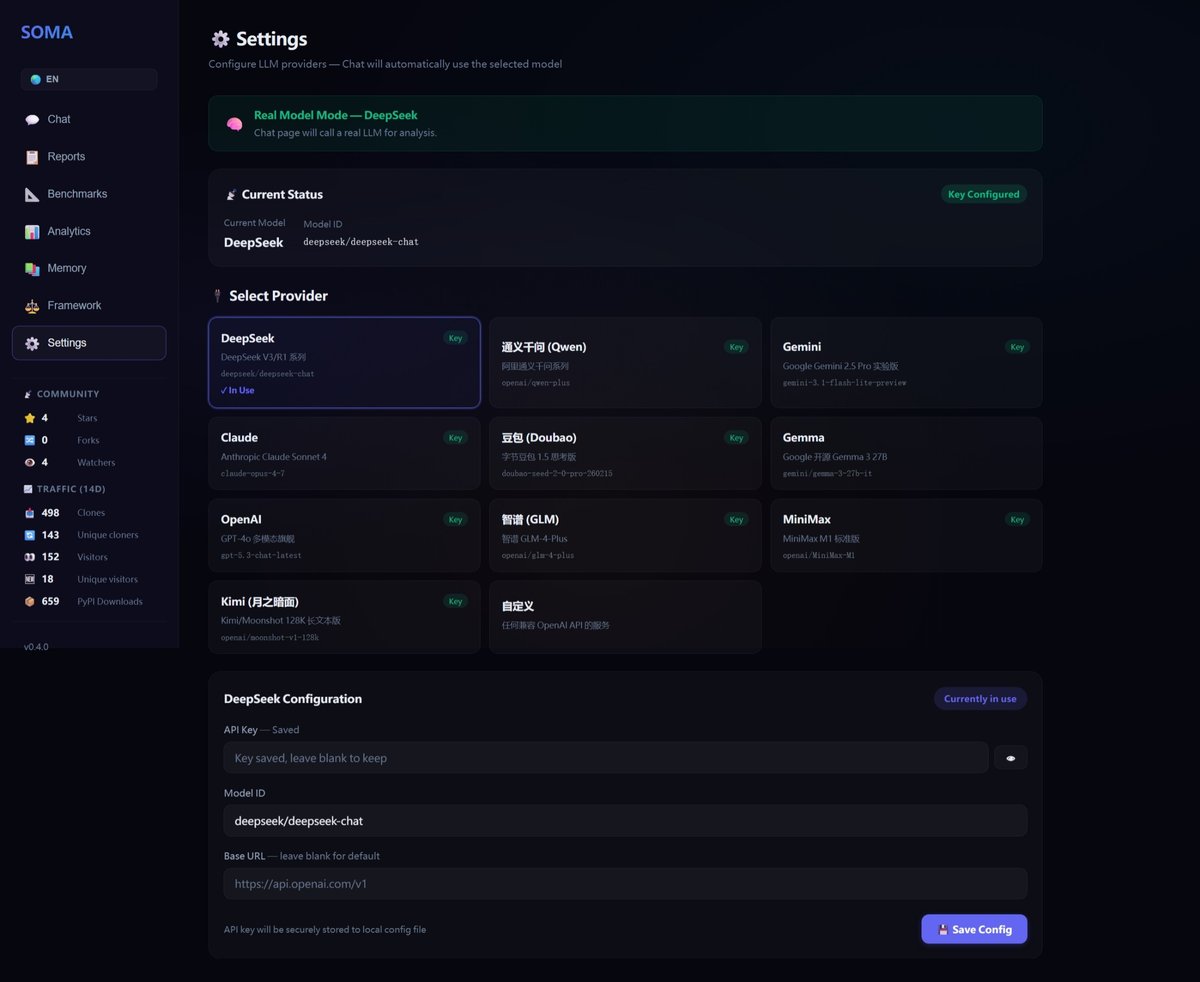
 |
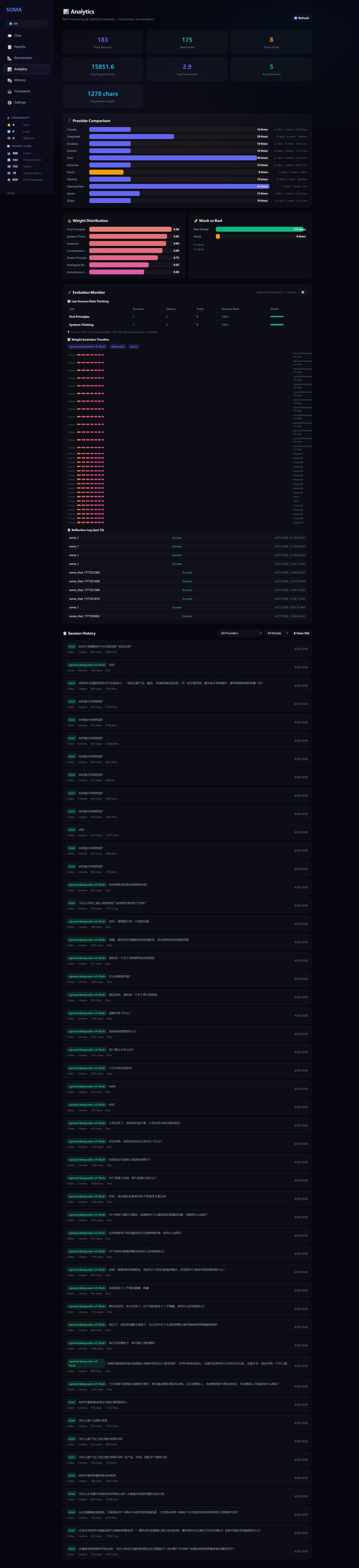 |
| IDE Integration — Claude Code / VS Code 一键接入,记忆自动持久化 | REST API — FastAPI + SSE 流式,多模型管理,API Key 认证 |
Start the API server and open http://localhost:8765:
SOMA_API_KEY=test python dash/server.pyVue 3 dashboard with i18n (English / 中文), 6 views: Chat · Framework · Memory · Analytics · Benchmark · Settings.
pip install soma-wisdomRequires Python 3.10+. The embedding engine uses ONNX Runtime for CPU inference — no CUDA, no Docker, no external services.
First run downloads a small ONNX model (~100 MB, Chinese-English bilingual).
python -m soma          # verify everything works in one command
soma-quickstart # or use the CLI entry point| Law | Description | Weight |
|---|---|---|
first_principles |
Reduce to fundamentals, derive from base elements | 0.90 |
systems_thinking |
See interconnected wholes, identify feedback loops | 0.85 |
contradiction_analysis |
Find opposing forces, identify principal contradictions | 0.80 |
pareto_principle |
Focus on the vital 20% that drives 80% of outcomes | 0.75 |
inversion |
Think backwards — how could this fail? | 0.70 |
analogical_reasoning |
Map structures across domains | 0.65 |
evolutionary_lens |
Observe change over time, identify lifecycle stages | 0.60 |
Customize in wisdom_laws.yaml (bundled in the package — always available).
New in v0.5: Laws are no longer a flat list — they form a reasoning network. When a law triggers, its relations propagate activation to related laws (×0.35–0.50 bonus). When two laws fire together, synthesized perspectives emerge (e.g., "First Principles × Systems Thinking → Root-Cause System Analysis").
Memories are matched through weighted Reciprocal Rank Fusion:
- Vector semantic similarity (×2 weight) via ONNX embeddings
- Keyword exact match (×1 weight)
Both directions compete and complement, producing true relevance scores.
SOMA tracks success/failure of each thinking law across sessions. Every 5 sessions, evolve() automatically:
- Memory consolidation: similar memories automatically merged, reducing redundancy
- Active forgetting: low-value memories archived with Ebbinghaus decay curves
- Bias detection: laws used >40% of the time get penalized (-0.05) to prevent thinking ruts; underused high-success laws get boosted (+0.03)
- Dynamic step sizing: adjustment magnitude scales with sample count (0.01 → 0.02 → 0.03)
- Skill solidification: successful (law, domain, outcome) patterns become permanent skills after 3+ occurrences
| Type | Storage | Search |
|---|---|---|
| Episodic | SQLite + vector BLOB | Hybrid (semantic + keyword RRF) |
| Semantic | SQLite triple store | Keyword + graph traversal |
| Skill | SQLite pattern store | Keyword + domain matching |
from soma import SOMA

soma = SOMA(
    framework_config=None,        # default: bundled wisdom_laws.yaml
    llm="deepseek-chat",          # LiteLLM model string
    use_vector_search=True,       # ONNX semantic search
    persist_dir="soma_data",      # persistence directory
    recall_threshold=0.01,        # minimum activation score
    top_k=5,                      # default recall count
)

# Wisdom pipeline
soma.respond(problem: str) -> str
soma.chat(problem: str) -> dict          # structured: foci + memories + weights

# Memory operations
soma.remember(content, context, importance) -> str  # returns memory_id
soma.remember_semantic(subject, predicate, object_, confidence)
soma.query_memory(query: str, top_k: int) -> list

# Introspection & evolution
soma.decompose(problem: str) -> list     # show thinking dimensions
soma.reflect(task_id, outcome) -> None   # record outcome for evolution
soma.evolve() -> list                    # trigger automatic weight adjustment
soma.get_weights() -> dict               # current law weights
soma.adjust_weight(law_id, new_weight)   # manual override
soma.discover_laws() -> dict | None      # autonomous law discovery
soma.approve_law(candidate) -> bool      # approve a discovered law
soma.stats -> dict # memory store statistics# Start server
SOMA_API_KEY=your-key python dash/server.py # → http://localhost:8765
# Standard chat
curl -X POST http://localhost:8765/api/chat \
-H "X-API-Key: your-key" \
-H "Content-Type: application/json" \
-d '{"problem": "How to improve team productivity?"}'
# SSE streaming (decompose → activate → delta → done)
curl -X POST http://localhost:8765/api/chat/stream \
-H "X-API-Key: your-key" \
-H "Content-Type: application/json" \
-d '{"problem": "Analyze our growth bottleneck"}'
# Memory search
curl -X POST http://localhost:8765/api/memory/search \
-H "X-API-Key: your-key" \
-H "Content-Type: application/json" \
-d '{"query": "growth strategy", "top_k": 10}'Set SOMA_API_KEY env var to enable authentication. Leave unset for local development.
from soma.langchain_tool import create_soma_tool
from soma.agent import SOMA_Agent
from soma.config import SOMAConfig, load_config

agent = SOMA_Agent(SOMAConfig(framework=load_config()))
tool = create_soma_tool(agent)
result = tool.run("Analyze this problem...")SOMA runs alongside AI coding tools as a persistent wisdom backend — it learns from every debug session, code review, and architectural decision.
# 1. Start SOMA server (once)
SOMA_API_KEY=dev-key python dash/server.py
Claude Code (Agent SDK) — use as a custom MCP server or REST tool:
# In your custom Claude Agent tool — persist insights across sessions
import requests
requests.post("http://localhost:8765/api/memory/remember",
    headers={"X-API-Key": "dev-key"},
    json={"content": "Bug: N+1 query in OrderService.getOrders, root cause: missing @BatchSize on items relation, fix: add Hibernate batch annotation + integration test", "importance": 0.9})
VS Code Extension — invoke via sidebar or command palette with a thin HTTP client wrapper.
Any IDE / CLI tool — just curl the REST API. No SDK required.
# Record a debug finding
curl -s -X POST http://localhost:8765/api/memory/remember \
  -H "X-API-Key: dev-key" -H "Content-Type: application/json" \
  -d '{"content":"Race condition in WebSocket handler: concurrent map writes on client.buf, root cause: missing mutex on write path, fix: sync.RWMutex around buffer ops","importance":0.9}'

# Recall relevant knowledge before starting a new task
curl -s -X POST http://localhost:8765/api/memory/search \
  -H "X-API-Key: dev-key" -H "Content-Type: application/json" \
-d '{"query":"concurrency websocket golang","top_k":5}'SOMA has been used in production across two distinct codebases — a Go-based CLI agent and a Python data platform — with the following results:
- Bug reoccurrence dropped significantly. When a bug fix is recorded as a SOMA memory (root cause + fix pattern), later sessions on the same codebase automatically retrieve it. Developers no longer re-debug the same class of issues across sprints.
- Architectural decisions became searchable. Each trade-off ("chose SQLite WAL over multi-worker for simplicity") is persisted with rationale context. Six months later, new team members can query "why single worker?" and get the original reasoning — not folklore.
- Cross-project knowledge transfer worked. A concurrency pattern learned in one codebase (the Go project) activated during debugging in the other (the Python project), because SOMA's semantic search matched "race condition" across language boundaries.
- Zero adoption friction. The Python project integrated via
pip install soma-wisdom+ 3 lines of code. The Go project integrated via REST API with a thin HTTP client (~50 lines). Neither required schema design, vector database setup, or infrastructure changes. - Evolution is automatic. After ~50 sessions, SOMA's auto-weighting surfaced that "Inversion" (thinking backwards from failure) was consistently the most useful lens for debugging tasks, while "Analogical Reasoning" shined during architecture discussions. The framework self-tuned — no manual knob-twisting needed.
SOMA v0.7.0 — benchmarked with 1,752 real production memories from 零熵智库:
| Dimension | Score | Grade |
|---|---|---|
| Overall | 84.8 | Excellent |
| Memory | 92.2 | Excellent — 100% recall, <4ms latency |
| Wisdom | 80.7 | Good — exploration factor active, diversity entropy 0.87 |
| Evolution | 71.9 | Good — 942 reflections, weight auto-adaptation |
| Scalability | 100.0 | Excellent — linear scaling at 1K |
| Metric | Value | Stability |
|---|---|---|
| Semantic Recall Rate | 100% | ● Stable |
| Dedup Ratio | 100% | ● Stable |
| Avg Insert Latency | 3.44ms | ◐ Acceptable |
| 1K Query Latency | 3.74ms | ● Stable |
| Decomposition Coverage | 100% | ● Stable |
| Thinking Diversity Entropy | 0.87 | ● Stable |
| Cross-Domain Activation | 100% | ● Stable |
| System | Recall@5 | Reasoning | Evolution | Consolidation | Forgetting |
|---|---|---|---|---|---|
| SOMA v0.7 | 100% | ✓ | ✓ | ✓ | ✓ |
| ChromaDB | 2.5% | ✗ | ✗ | ✗ | ✗ |
| Mem0 | * | ✗ | ✗ | ✓ | ✗ |
| Zep | * | ✗ | ✗ | ✓ | ✗ |
SOMA is the only system combining a reasoning framework, evolutionary self-optimization, memory consolidation, and active forgetting — all without external services.
Full report: TEST_REPORT_v0.7.0_FINAL.md | CHANGELOG.md
pip install soma-wisdom chromadb
python -m soma.benchmarks --full --runs 5 --output reports/    # statistical benchmark
python scripts/live_benchmark.py --full --output reports/ # live competitor testgit clone https://github.com/soma-project/soma-core.git
cd soma-core
pip install -e ".[dev]"
pytest -v --cov=soma --cov-report=term # 342 tests, ~97% coverage
python -m soma # quickstart verification
python dash/server.py # API server (http://localhost:8765)soma-core/
├── soma/ # Core library
│ ├── __init__.py # SOMA facade (zero-config entry)
│ ├── __main__.py # python -m soma quickstart
│ ├── agent.py # SOMA_Agent: pipeline orchestrator
│ ├── engine.py # WisdomEngine: problem decomposition
│ ├── hub.py # ActivationHub: bidirectional activation
│ ├── evolve.py # MetaEvolver: reflection + auto-evolution
│ ├── embedder.py # SOMAEmbedder: fastembed + ONNX encoding
│ ├── vector_store.py # NumpyVectorIndex: faiss ANN search
│ ├── config.py # Pydantic configuration models
│ ├── base.py # Data models (Focus, MemoryUnit, etc.)
│ ├── abc.py # Abstract base classes
│ ├── langchain_tool.py # LangChain BaseTool wrapper
│ ├── law_discovery.py # Autonomous law discovery from clusters
│ ├── retry.py # LLM retry with exponential backoff
│ ├── plugin.py # Entry-points plugin auto-discovery
│ ├── analytics.py # Usage analytics & benchmark storage
│ ├── benchmarks.py # 5D benchmark engine (memory/wisdom/evolution/scalability/overall)
│ ├── wisdom_laws.yaml # Default thinking framework (bundled)
│ └── memory/
│ ├── core.py # MemoryCore: unified memory facade
│ ├── episodic.py # EpisodicStore: SQLite + vector BLOB
│ ├── semantic.py # SemanticStore: knowledge triples
│ ├── skill.py # SkillStore: learned patterns
│ ├── consolidation.py # ConsolidationEngine: memory dedup
│ ├── forgetting.py # ForgettingEngine: Ebbinghaus decay
│ ├── external.py # External knowledge import (Markdown/JSON/URL)
│ └── search_utils.py # FTS5 shared search utilities
├── dash/ # Dashboard & API server
│ ├── server.py # FastAPI (REST + SSE streaming + auth)
│ ├── providers.py # LLM provider manager
│ └── frontend/ # Vue 3 dashboard UI (i18n: EN/ZH)
├── docs/ # Documentation (EN + ZH bilingual)
├── tests/ # 196 tests, ~97% coverage
├── examples/ # Usage examples
└── pyproject.toml # Build config
@software{soma2025,
  title        = {SOMA: Somatic Wisdom Architecture},
  author       = {SOMA Project Team},
  year         = {2025},
  url          = {https://github.com/soma-project/soma-core},
  note         = {Apache 2.0},
}Apache License 2.0. See LICENSE.
🧠 五分钟接入,给你的 Agent 一个会思考的灵魂